Strong seeds. The essence of the concept
The essence is simple - this is that part of the seeds that the plant, during the process of formation, endowed with greater germination power and higher productivity in order to preserve the population, regardless of the conditions in the next season.
Let us consider this concept in more detail using the example of wheat. Careful studies have shown that even in the ear of the main stem, the sowing and yield qualities of the seeds are very different. The different quality of seeds as a result of different locations of the achenes (caryopsis) on the mother plant is due to different nutritional regimes and different influences of the mother plant. This is explained by the fact that the initiation of spikelets and flowers, and flowering begin in the middle of the spike or closer to the lower third and continue from there evenly to the base and top of the spike (Fig. 1).
There is a more or less pronounced medial dominance: in the middle of the ear, the formed spikelets are larger, have more flowers and caryops, and the mass of individual grains in this part of the ear is the highest. Seeds of the first periods of formation have higher biological and productive qualities. If the field’s agricultural background is strong and weather conditions are favorable, then other seeds will be produced, but their potential will still not be equal to those previously formed (Fig. 2).
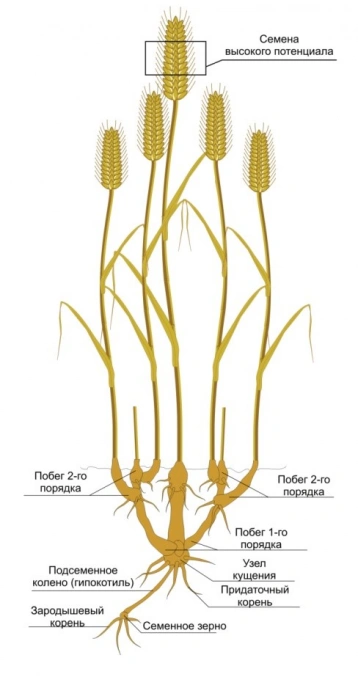
Rice. 1. Wheat tillering and seed formation.
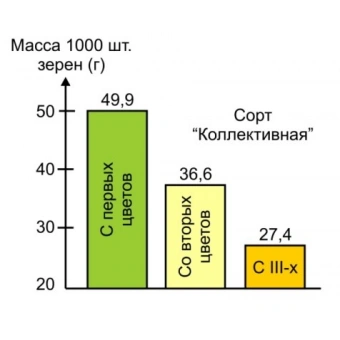
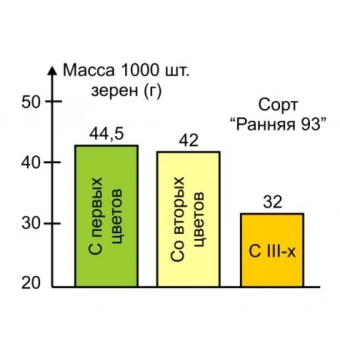
Rice. 2 The influence of maternal variation in quality on the weight of 1000 pcs. (d) spring wheat seeds
(N.V. Novitskaya, 2008)
The first seeds have a denser “packing” of molecules and a quantitatively different chemical composition. So, the mass is 1000 pcs. of spring wheat grains selected from different parts of the ear differs by 30-45% (Fig. 3).
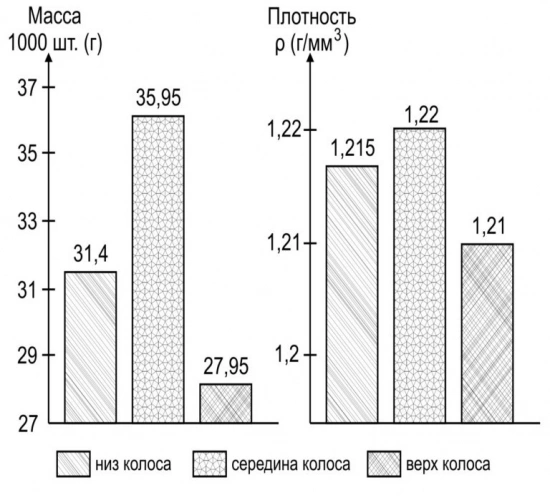
Rice. 3. Weight 1000 pcs. grains (g) and density (g/mm³) of grains of different parts of the ear.
Therefore, seeds from the central part of the ear in the next generation produce larger grain sizes and a weight of 1000 pieces. seeds, and this, as it turns out, determines the yield.
Here are the data given in the book “Cereal Crops” by Dieter Spaar, 2012 [1]:
| Index | Seeding rate (germinating grains), pcs/ m2 | |
| 300 | 450 | |
| Nitrogen fertilizer (kg N/ha) | 50+50 | 50+50 |
| Stems ( pcs./m2 ) | 1046 | 1492 |
| Koloskov, ( pcs./m2 ) | 557 | 675 |
| Grains in a spikelet, (pcs.) | 34 | 29 |
| Weight 1000 pcs. seeds (g) | 45.1 | 42 |
| Productivity (c/ha) | 85.1 | 81.3 |
| Rice. 4. Dependence of yield on the grain content of the ear (D. Spaar, 2012 [1]. | ||
The table (Fig. 4) shows that even with a reduction in the seeding rate by more than 30%, strong seeds due to the grain size of the ear and grain size ensured higher yields.
In oats, the most reproductive seeds are formed at the end of the panicle in the same way as in millet, sorghum and other paniculates, but in buckwheat, on the contrary, the lower grains form and ripen earlier than the rest. Studies have shown that seeds of the first stages of formation in wheat, oats and other cereal grain crops form a yield 15-57% higher than the control (S. M. Kalenskaya, 2011, [2]). It is these large and heavy seeds of the upper tiers of plants that are the starting material for the preparation of strong seeds . For already at this stage the potential of the seeds, determined by their location on the mother plant, is manifested.
As you know, wheat roots are divided into two types: germinal (primary) and adventitious (secondary, stem) . The embryonic roots are in the embryonic state of the wheat grain. Grain germination sequentially passes through certain phases, the first of which is the swelling phase, i.e. absorption of water by the grain. When the grain swells, water penetrates through the shell into the colloidal tissues of the grain and fills the capillaries and intercellular space. Swelling is a physical process, the intensity of which depends both on environmental conditions and on the chemical composition of the grain. The required amount of water absorbed by a wheat grain to begin germination is 43-44% of its mass. Investigating possible ways to obtain friendly shoots, E. G. Kizilova (1961) revealed the dependence of the intensity of wheat grain swelling on the temperature in the seed bed, with optimal soil moisture [3]. It can be seen that the exponential dependence - increasing temperature - sharply reduces the swelling time (Fig. 5).
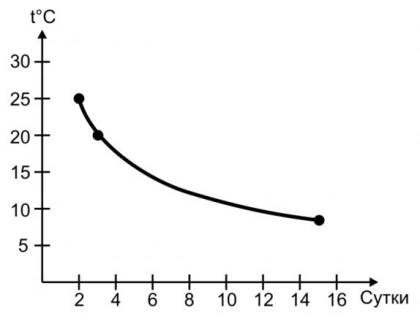
Rice. 5. The intensity of wheat grain swelling depending on the temperature in the seed bed [3].
This is explained by the fact that the grain is not just a porous substance, but a living being, and the moisture entering it enters into colloidal processes, the rate of which is highly dependent on temperature. In addition, the absorption capacity of the grain components (starch, protein and fat) differs significantly. Bogdanov S.M. (1988), studying the need for water for germinating seeds, convincingly showed this difference (Fig. 6) [4].
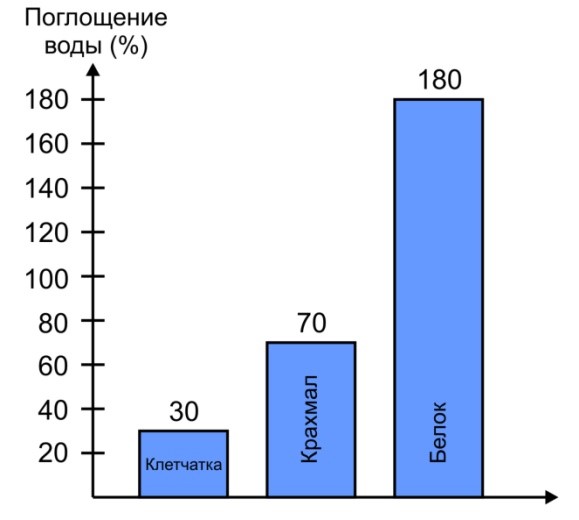
Rice. 6. The ability to absorb water by different components of wheat grain [4].
This is important for grain germination, because enzymes for breaking down carbohydrates, fats and proteins into simple forms of sugars necessary to nourish the embryo can only act in the composition of water. And since enzymes are activated in the embryo and aleurone layer as they move towards the endosperm, the high swelling ability of the protein, the share of which is 30% in the aleurone layer and 26% in the embryo , contributes to the activity of the germination process in the initial phase.
The irreversibility of the germination process begins from the moment of swelling of the main germinal root and, as a consequence, rupture of the membrane and its exit from the vagina [1]. Subsequent embryonic roots germinate with a certain delay after the main root.
The embryo is separated from the endosperm by a shield, which doses the amount of nutrients supplied from the endosperm to the embryo. And in the scutum itself there are cells capable of secreting enzymes and, apparently, they are the first to begin producing nutrition for the embryo. The endosperm starch is completely consumed during the germination of the achene and this is enough nutrition for the germination of the germinal roots (up to seven in strong wheat seeds), the stem and the first leaves (up to the fourth in strong seeds). It is characteristic that the aleurone layer is the last to “leave the post” and retains its shape until the plant fully germinates. The germination process of barley achenes is shown in Figure 7.
From all that has been said, it is clear that there is nothing superfluous in the grain, everything in it is packed for the future plant, and any injury disrupts the life of the grain, for the grain is a living creature created by nature and endowed with the ability to reproduce its own kind.
With the appearance of hairs on the germinal roots , they begin to provide the sprout with water and nutrients.
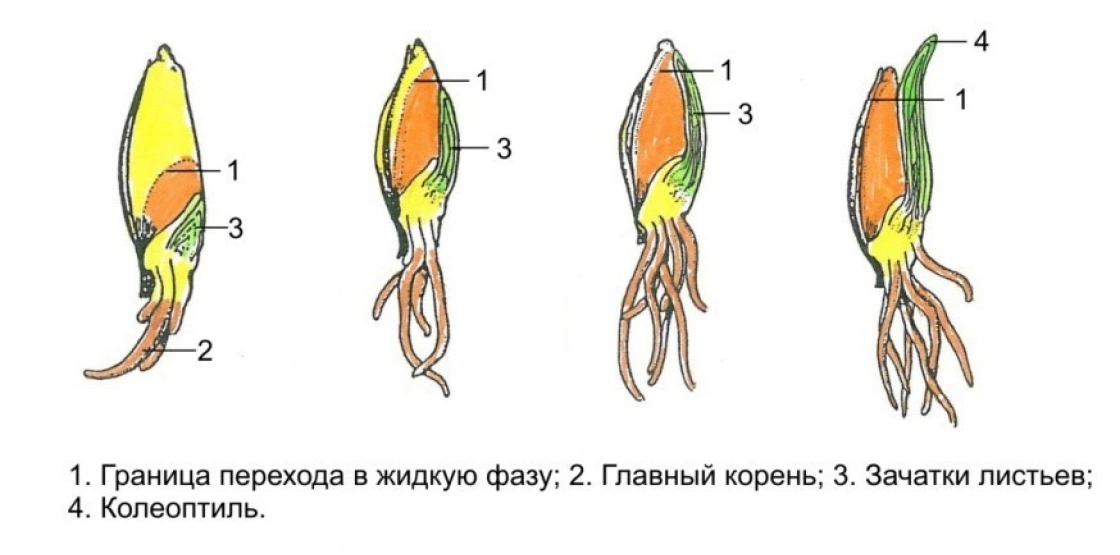
Rice. 7. The process of transition of nutrients from the barley achene into the liquid phase.
Thus, the beginning of plant growth occurs only due to the consumption of nutrients found in the endosperm, which are broken down by enzymes into simple forms and enter the embryo in the liquid phase through the scutellum for the development of the primary root system and embryonic stem. That is why the amount of nutrients plays a huge role, i.e. size and density of the grain endosperm .
A large grain not only has a larger embryo , which is natural, but it is also remarkable that it is larger even in relative comparison. Thus, Mambish I.E. (1953), studying the weight ratios of the constituent parts of wheat and determining the masses of the embryo in small and large grains of wheat, both in absolute and relative values, showed the advantages of large seeds (Fig. 8) [ 5].
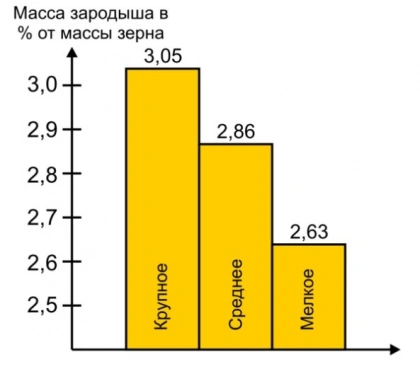
Rice. 8. Comparison of the relative mass of the embryo (%) for wheat grains of different sizes [5].
That is why large, heavy wheat seeds produce even, powerful seedlings, since the primary (embryonic) roots and first leaves are formed practically only due to the nutrients of the achene. The power of the embryonic roots and the area of the first leaves directly depend on its size.
Subsequent leaves, including up to the fourth, are formed from two sources - nutrients supplied through the embryo from the caryopsis, and from the embryonic roots that have begun their “work”. After the grain’s nutrients are consumed, further development of the plant occurs due to germinal roots , since the development of adventitious roots, according to the author M. G. Prutskova (1976), in a favorable year begins approximately 18 days after germination, and in a dry year - after 28 days [6].
Germinal roots quickly grow in depth and, when a depth of 71-100 cm is reached, they are twice as deep as the adventitious ones; in addition, they do not die off when the secondary root system appears and develops, and accompany all the main phases of plant development, right up to the milky-waxy ripeness of the formed in an ear of grain. In this regard, it is necessary to return again to the importance of large wheat seeds , since their extremely important property is that the number of embryonic roots in large seeds is greater than in small ones .
Thus, Romashchenkov D. D. (1951), studying the dependence of the germination energy of spring wheat on the formation of primary roots , provides data that, as part of his research, more than 80% of large seeds had 5 embryonic roots , and 80% of small seeds have 3-4 embryonic roots (Fig. 9, 10) [7].
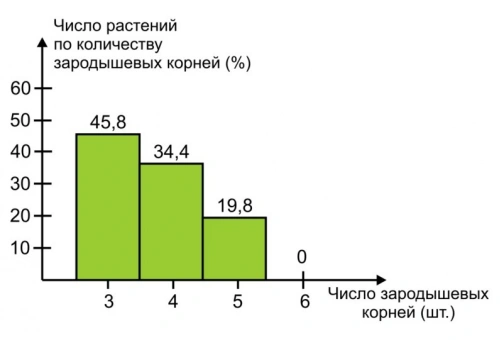
Rice. 9. Number of plants (%) by the number of embryonic roots in small wheat seeds (weight of 1000 pieces - 22 g)[7].
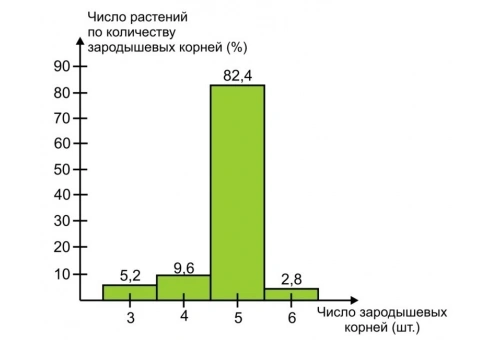
Rice. 10. Number of plants (%) by the number of embryonic roots in large wheat seeds (weight of 1000 pieces - 43.3 g) [7].
The role of embryonic roots in ear formation in winter and spring wheat is different. If in winter wheat secondary roots appear in the fall and reach great depths before heading, which ensures the yield of lateral shoots close to the yield of the main shoots, then in spring wheat the picture is different. Secondary roots are formed 25-35 days later than the embryonic ones , they lie shallower, and the main load on the formation of the crop falls on the embryonic roots . Thus, research by Nosatovsky A.I. [8] showed that the share of the yield provided by the embryonic roots is no less than 70% of the yield formed by the entire root system of the plant. If we assume that the given data for comparing the productivity of embryonic roots refer to their average number (3-4 pcs.), then the number of germinal roots of large seeds , with their number of 5-6 pcs., can provide even greater productivity in the absence of secondary roots. The role of embryonic roots for spring wheat (durum wheat) is especially high in dry years, when secondary roots do not develop in the dry soil layer, and the entire crop is formed only by embryonic roots . In this case, large seeds , in fact, are a means of reducing crop losses from drought due to a larger number of embryonic roots , going into the soil to a depth of 2000 cm or more, while stem roots in the upper dehydrated layer of soil practically stop their vital activity.
It also follows from the above that a large wheat achene , due to its great potential, high germination energy and content of a larger amount of initial nutrients, can reliably germinate from a greater depth of seed placement during sowing (Fig. 11), which reduces the risk of freezing for winter crops and increases field germination in case of moisture deficiency during the sowing period, which is especially important for spring durum wheat varieties, since the swelling of glassy grains occurs slowly, and in this phase they must be in moist soil. Thus, in the studies of Zadontsev A.I. and Bondarenko V.I., large seeds of winter wheat in arid conditions germinated even from a depth of 12 cm, while small seeds gave weak seedlings, and many did not germinate at all [9].
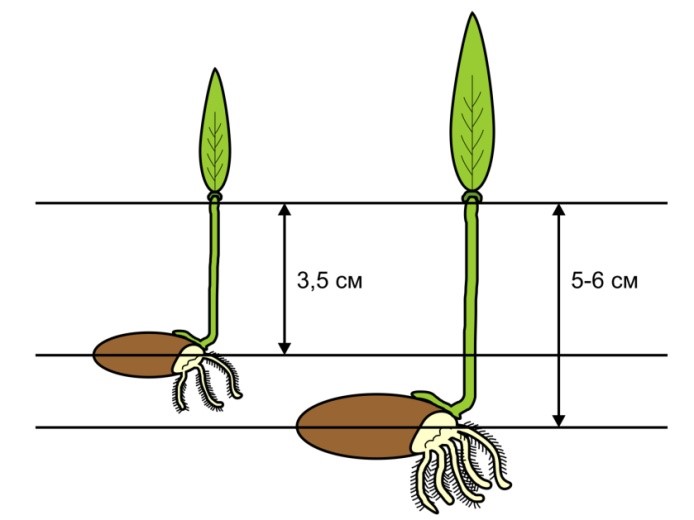
Rice. 11. Scheme of germination of small and large seeds.
In addition, you need to pay attention to the following.
The basal leaves are in a rudimentary state in the embryo.
After the third leaf emerges, the tillering phase of the main stem begins. Side shoots of the 2nd order are formed. [10].
The vigor of growth, the size of the first leaves, and the intensity of tillering depend on the potential of the achene and the number of embryonic roots. In fact, this is the foundation of the future harvest.
It is interesting that even in the mid-tillering phase, the formation of the spikelet (the number of segments of the spikelet) has already begun and the future number and size of spikelets is determined [10]. All this before the tillering phase is completed and the plant enters the tube [10]. It is at this phase of plant development that the future harvest is laid, and since at this stage nutrition is provided only by the embryonic roots, their number is fundamentally important - 3...4 as in ordinary seeds, or 5...6 as in strong seeds.
From all of the above it follows that strong seeds are the basis on which the future harvest is formed.
The gentle fractional technology we are introducing for the production of strong seeds confirms this in practice.
This is the technology that forms the basis of the seed factories we produce (Fig. 12).
At such a plant, exclusively STRONG SEEDS of various agricultural crops are prepared.
Their distinctive features:
- absence of both macro- and microtraumas
- large seeds
- seeds calibrated by size and shape
- heavy seeds
- seeds treated with various preparations and inoculants.
* STRONG SEEDS is a registered trademark. Read more here.
List of used literature:
- Spaar D. Grain crops: cultivation, harvesting, storage and use. – K.: Publishing house “Zerno”, 2012. – 704 p.: ill.
- Knowledge and methods of extracting the nutritional value of agricultural crops: Basic handbook / Edited by S. M. Kalenskaya. - Chief assistant. – Vinnytsia: FOP Danilyuk, 2011. – 320 p.
- Kizilova E. G. Study of seed germination during the sowing-emergence period to substantiate methods for obtaining timely and friendly shoots: abstract of thesis. Ph.D. dis. –Kh., 1961. – 23 p.
- Bogdanov S. M. Requirement of germinating seeds for water // News of Kyiv University. –K., 1988. – 23 p. (separate print).
- Mambish I.E. Weight ratio and ash content of wheat components // Tr. VNIIZ. – M., 1953. – Issue 25.
- Prutskova M. G. Guidelines for approbation of agricultural crops (cereals, cereals and leguminous crops). – M.: Kolos, 1976. – 376 p.
- Romashchenkov D.D. Dependence of tillering energy of spring wheat on the formation of primary roots // Dokl. Academician Sciences of the USSR. – 1951. – T. 79, No. 2. – pp. 349-352.
- Nosatovsky A.I. Wheat. Biology: 2nd ed. add. – M.: Kolos, 1965. – 568 p.
- Zadontsev A.I. Factors influencing winter hardiness of winter wheat / A.I. Zadontsev, V.I. Bondarenko//International. agricultural magazine – 1965. – No. 4. – P. 4-48.
- Phases of grain development and the process of crop formation (Agronomist No. 4, Listopad 2019)