Traditional Technologies Vs “Strong Seeds” Technologies
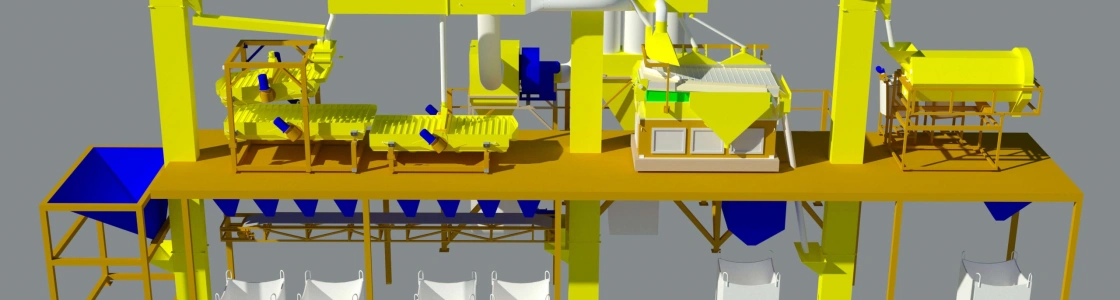
Already in eight countries there are factories producing STRONG SEEDS (gentle fractional technology of the 21st century), but Ukrainian farmers, by inertia, continue to purchase seed factories operating using outdatedtraditional technology .
I bring to your attention evidence-based material comparing these technologies. In Fig. 1 shows the corresponding diagrams.
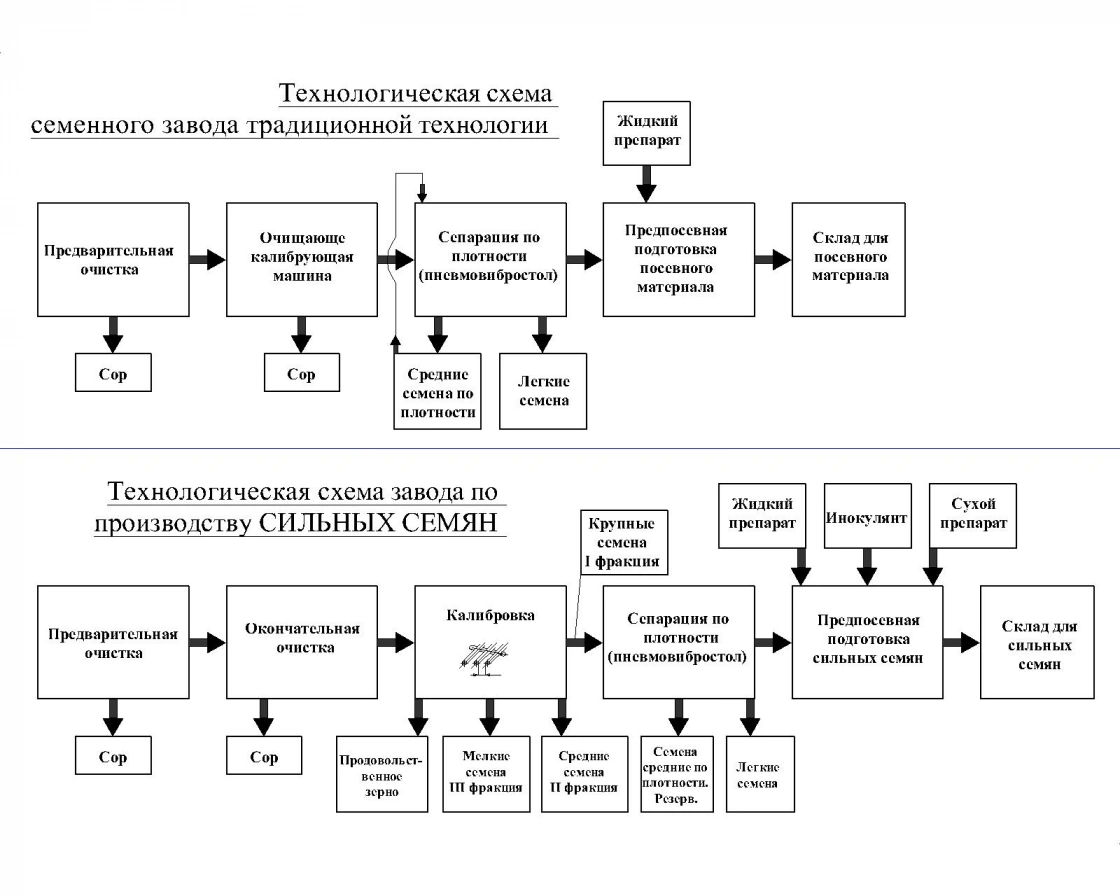
Fig. 1. Schemes of different technologies of seed factories.
I’ll immediately focus on the differences
- In traditional technology, before separating seeds by density, a cleaning and calibrating machine is installed, on which size calibration can be performed for a maximum of three fractions in one pass, of which one is large (coming from the upper sieve (sieve) )) contains oversized grains and is under-ground. The second fraction, coming off the middle sieve (sieve), has a big difference in the size of the seeds, since puny, small seeds are removed from it (passage), and all the rest remain in the middle fraction.
When preparing STRONG SEEDS, a special calibrating part of the technology allows you to calibrate any seeds into 5...6 fractions (Fig. 1a)
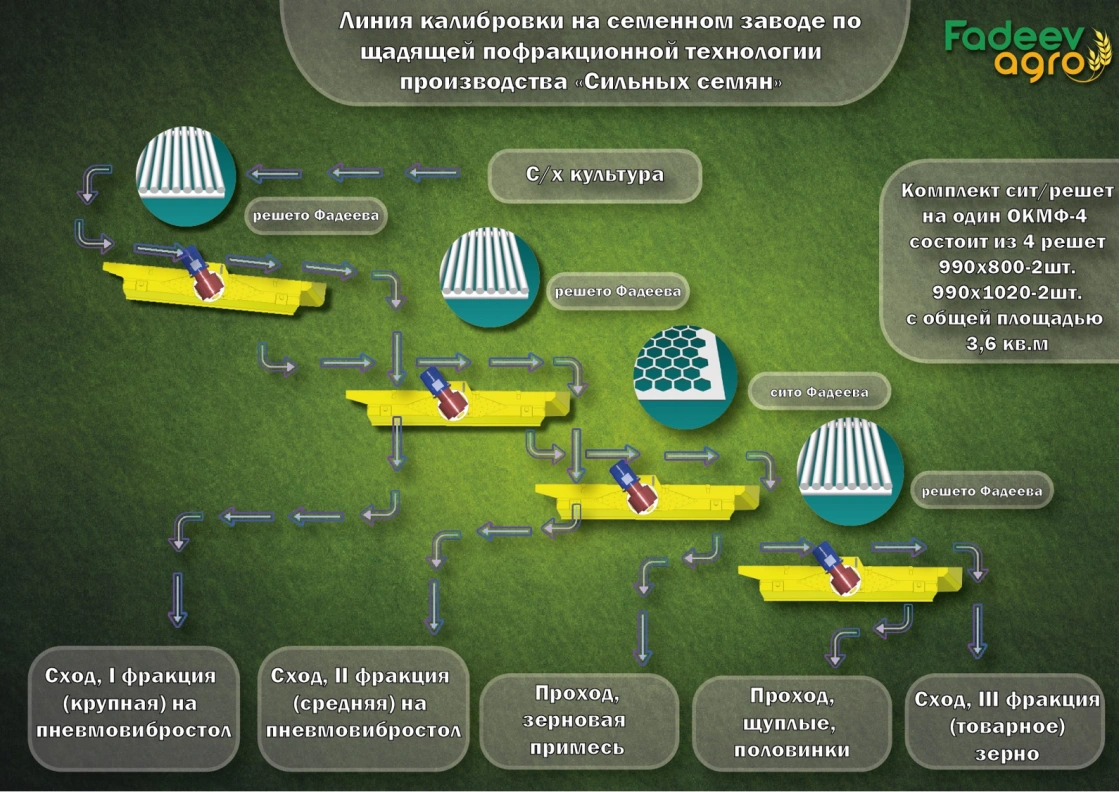
(Fig. 1a)
- —grain admixture
- — puny seeds (halves of legumes)
- —III fraction according to the thickness of the achenes
- —II fraction according to the thickness of the achenes
- —I fraction according to the thickness of the achenes
- —underground, hypertrophied (in particular, paired, erect sunflower seeds) seeds come off the last sieve.
- In traditional technology seeds with a large difference in seed thickness are supplied to the pneumatic vibration table, i.e. seeds with different washed surfaces, which does not allow the ascending air flow to strictly separate the seeds by density (weight of 1000 pieces), because achenes differ in size, shape, and density.
A different picture when producing Strong Seeds. The pneumatic vibration table receives seeds that are strictly fulfilled according to two indicators: the shape and thickness of the achenes. At the same time, the influence of air on them is the same and their division by density (heavier ones below the light ones) occurs very precisely.
In addition, in traditional technology the seeds are of medium density ; return to the pneumatic vibration table and worsen density separation, because again they find themselves in the middle of leaving the pneumatic vibration table.
In the technology for the production of Strong seeds, medium-density seeds are allocated as reserve, if necessary (shortage of heavy seeds) they can be re-directed to the pneumatic vibration table to separate some of the heavy seeds from them.
- The machine for pre-sowing treatment of Strong seeds allows the application of both microelements and inoculants, since they are supplied to the working chamber by separate systems with autonomous regulation of the consumption of preparations. In addition, the design of the sowing machine allows for pelleting of seeds.
And, lastly, during the pre-sowing treatment of Strong seeds, injury is absolutely excluded, since only the drug gets onto the rotating plate (disc nozzle), and its application to the seeds occurs when the seeds move coaxially and completely uniform redistribution of the drug occurs during mutual contact of achenes in the working chamber. Pelleting is ensured by dosed supply of finely dispersed material directly into the mixing chamber after applying the preparation with adhesive to the seeds.
It is this technology that allows you to get Strong Seeds ™, unlike traditional technology.
In Fig. Figure 2 shows the results of isolating STRONG SEEDS from seed material obtained after it was prepared for sowing at atraditional technology plant.
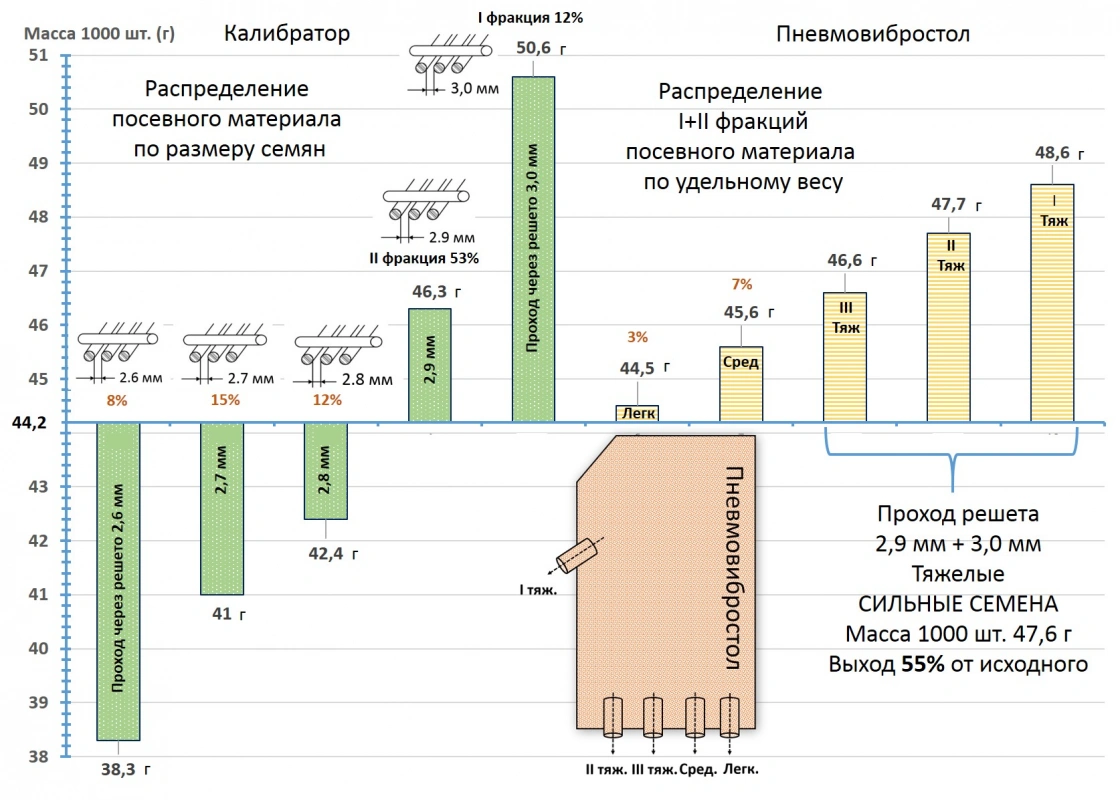
Fig.2. The result of the analysis of the quality of wheat seeds prepared for sowing usingtraditional technology(weight of 1000 pieces 44.2 g is taken as the basis).
The starting material had a mass of 1000 pcs. seeds 44.2 g
Strict calibration showed that seeds passing through 2.6 mm sieves; 2.7 mm; 2.8 mm, have a mass of 1000 pcs. seeds 38.3 g; 41.0 g; 42.4 g, respectively, which is noticeably lower than the average value of 44.2 g (Fig. 3)
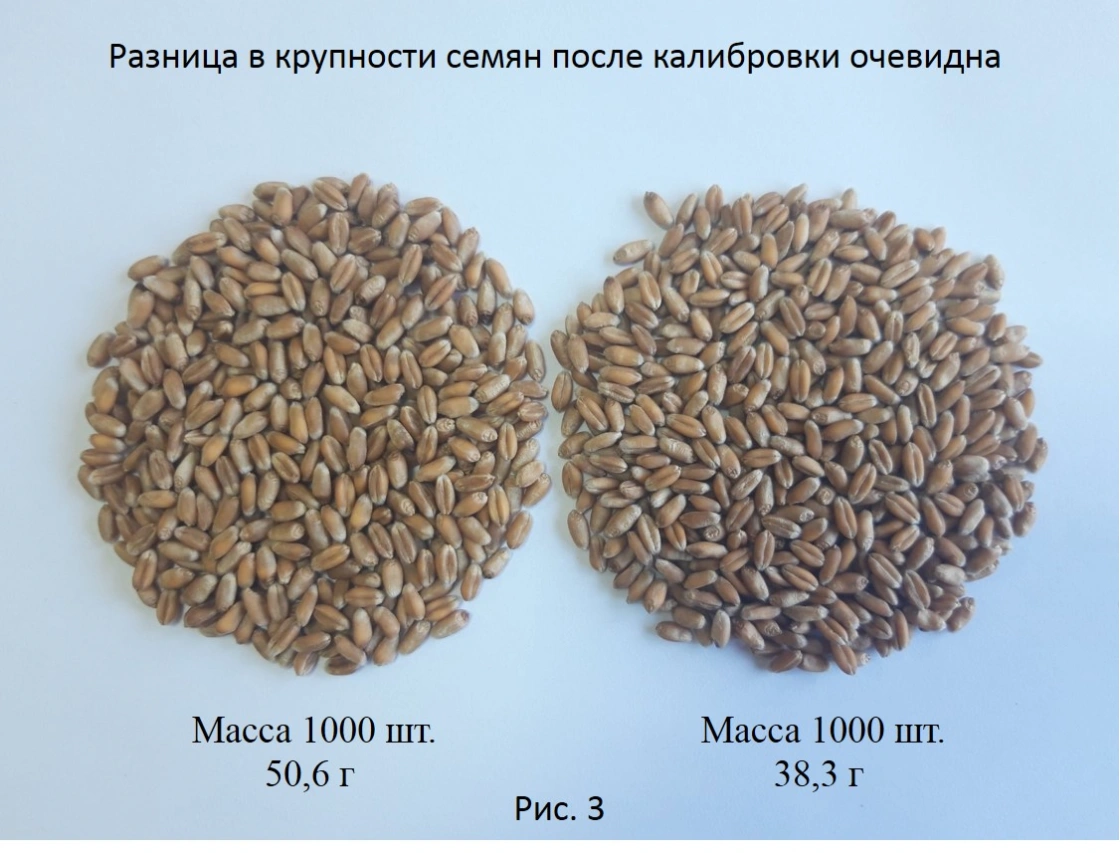
Seeds passed through 3.0 mm and 2.9 mm sieves by weight 1000 pcs. seeds are significantly higher than the average value of 50.6 g and 46.3 g, respectively.
Since the seeds weigh 1000 pcs. below the average value (44.2 g), it is not advisable to sow them due to low productivity, then large seeds were sent to the pneumatic vibration table to isolate STRONG SEEDS.
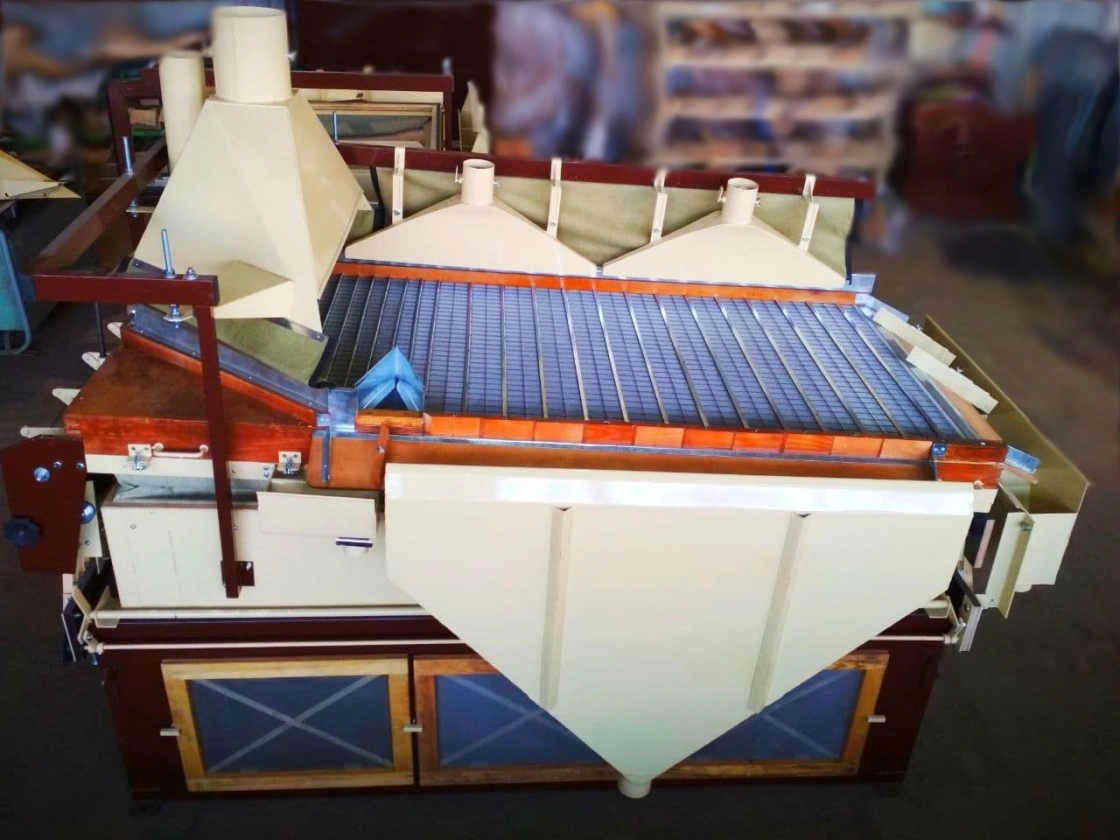
Fadeev Pneumatic Vibration Table (PVSF)
On a pneumatic vibration table, large seeds were divided into light, medium and heavy, weight 1000 pcs. which respectively amounted to 44.5 g; 45.6 g; 47.6 g (average heavy). STRONG SEEDS are those that are heavy, since they are larger and denser than others and are naturally more productive.
Do not sow the light ones, medium in density (weight of 1000 seeds is 45.6 g) in reserve, but sow the heavy ones. The total yield of STRONG SEEDS from the batch of seed prepared by traditional technology received by us was only 55%.
Note. The first fraction in terms of seed size (weight 1000 pieces 50.6 g) is STRONG SEEDS from the middle of the central ear, and II and III fractions, these are STRONG SEEDS from the middle of the ears of the first and subsequent layers of wheat. These seeds are heavier than others in the ear, but they can be isolated on a pneumatic vibration table only if the washed surfaces of the seeds are identical, i.e. strictly calibrated in size (thickness) and shape.
Since, in the batch given to us, the seeds of fractions II and I (after the calibrator) were not enough for fractional separation of STRONG SEEDS on a pneumatic vibration table, we had to combine these fractions (average weight 1000 pcs. seeds amounted to 47.7 g) before density separation. With a larger amount of starting material, it is necessary to isolate STRONG SEEDS from each fraction separately. Then the sowing rate will differ in size pcs., kg/ha for fractions I, II and III, but all fractions will contain STRONG SEEDS. For propagation areas (seed production) and for breeding purposes, all fractions must be sown separately. For commercial grain, preference is given to the first.
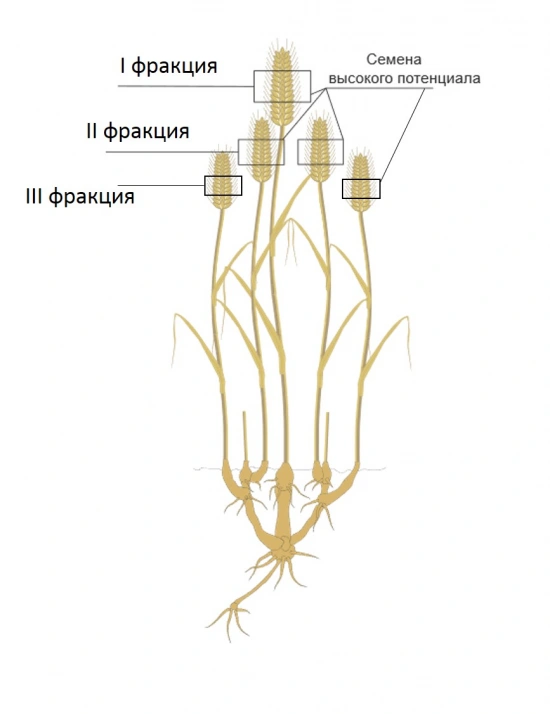
Fig. 4.
STRONG SEEDS of fractions I, II and III in the central part of the ear.
They are denser than other seeds in the ear.
It’s not a pity that half of the seed material will go into food grain. STRONG SEEDS ™, when the seeding rate is reduced by at least half, on the same areas will produce a larger wheat yield and higher quality grain. In addition, you will spend less money on protection from diseases and on feeding - STRONG SEEDS - STRONG PLANT.
Good luck.
With respect, Ph.D. Associate Professor Fadeev L.V.